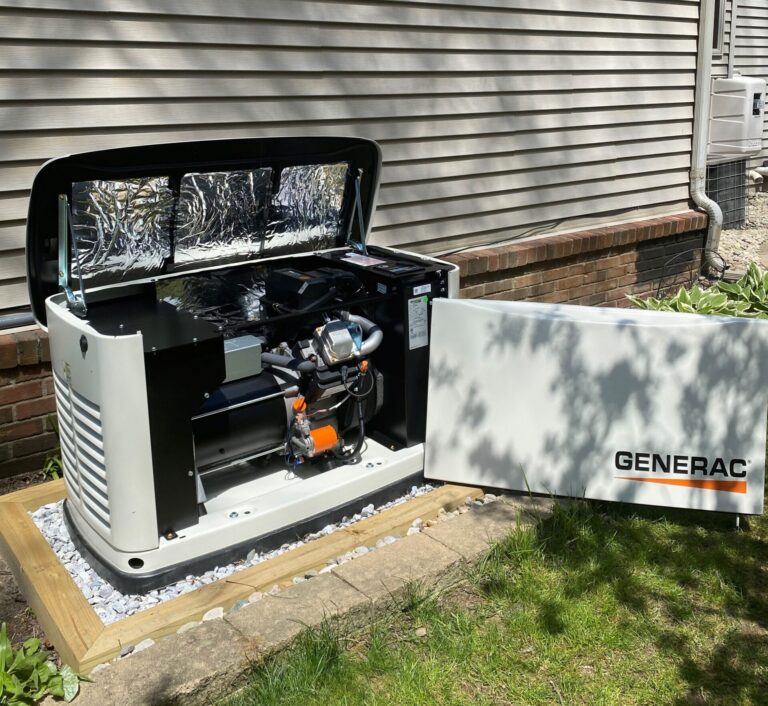

Most homeowners have never had a Generac generator installed, so it’s hard to know what the process looks like, how long it takes, or what you’ll need to do until you’re in it. A whole home generator installation is a planned project with a clear order: a site visit, a design for your home, permits, installation, and testing. Each step builds on the one before it, and our team handles the work while you make a few key decisions along the way.
Below, we walk through what happens at each of the 5 steps to install a Generac generator, how long each part tends to take relative to the others, what we’ll ask of you, and how we decide where the generator goes on your property.
Step 1: Consultation and Site Visit
Every project starts with a conversation. You fill out our short form or call us, and we reach out to learn about your home, your outage concerns, and what you want to keep running when the power goes out.
Next, a generator specialist visits your property in person. During the site visit, we review:
- Your electrical panel and the loads on it
- Your property layout and possible generator locations
- Your fuel source, which is either a natural gas line or a propane tank
The site visit usually takes one appointment, and it shapes everything that comes after.
What you’ll do: Make a list of the appliances and systems you can’t go without, such as heat, a well pump, a sump pump, or medical equipment. Let us know about any plans to add a heat pump, an electric vehicle (EV) charger, or an addition, since those loads can change the generator size you need.
Step 2: System Design and Sizing
After the site visit, we design a system around your home. That means choosing the generator size, deciding between whole-house coverage and a selected group of essential circuits, and determining whether load management makes sense. Load management briefly turns off lower-priority appliances so the generator can keep powering the important ones, letting a smaller generator cover more of your home.
We recommend a model from our lineup of Generac whole-home generators and send you a quote that covers the full installation.
What you’ll do: Review the recommendation and quote, ask any questions, and approve the project when you’re ready. If you’d like to spread out the cost, this is a good time to ask about our generator financing options.
Step 3: Permits and Utility Coordination
Once you approve the project, we handle the permits. A standby generator involves electrical work and a fuel connection, so it typically requires permits and inspections under your town and state rules. Our team manages the required permits, coordination, and preparation, so everything is approved before installation begins.
This step may also involve us coordinating with your natural gas utility or propane supplier. For a natural gas connection, the meter and gas piping must be able to supply the generator in addition to your other gas appliances. For propane, your supplier may need to set or upsize a tank. Permits and fuel coordination often depend on schedules outside our control, so this step usually has the most waiting time.
What you’ll do: Very little. We may ask you to sign permit paperwork or contact your propane supplier, and we’ll tell you if anything is needed.
Step 4: Installation Day
With permits approved, our in-house technicians arrive to install the system. The core work is typically completed during the installation visit, and it includes:
- Preparing the site and setting a level pad for the generator
- Placing the generator in the location chosen during the site visit
- Installing the automatic transfer switch (ATS), which senses an outage, disconnects your home from the utility line, and switches your circuits to generator power
- Making the electrical connections between the generator, the transfer switch, and your electrical panel
- Connecting the fuel supply from your natural gas line or propane tank
We do all of this work to code and to the manufacturer’s installation instructions. Your power is typically shut off for part of the day while we connect the transfer switch to your panel, and we’ll let you know when to expect that.
What you’ll do: Make sure our crew can reach the work area and your electrical panel. If needed, move vehicles and clear snow or stored items from the path to the generator location.
Step 5: Testing, Walkthrough, and Ongoing Support
After installation, our technicians start and test your generator to confirm it runs properly and transfers power as expected. Any required inspections take place around this point.
Then we walk you through how your generator works, including what it does during an outage and how it runs a short self-test on a schedule between outages. Generac’s Mobile Link app lets you check your generator’s status and receive alerts from your phone, and we can help you get it set up.
Our support continues long after installation day. Our generator maintenance plans cover the routine service that keeps a generator ready year after year, and our team handles generator repairs if something needs attention.
What you’ll do: Be home for the walkthrough, ask questions, and download the Mobile Link app if you’d like remote monitoring.
Where the Generator Can Go on Your Property
Fire codes and the manufacturer’s installation requirements set generator placement. Generac notes that a standby generator is typically installed close to your fuel source, and that its installation guide sets the exact clearance requirements for each model.
In New Hampshire, the State Fire Marshal’s Office has published a bulletin explaining that the state follows NFPA 37, the National Fire Protection Association (NFPA) standard for stationary engines. NFPA 37 sets minimum distances between an outdoor generator and openings in a home’s walls, such as windows, doors, and vents, and between the generator and combustible walls. The bulletin also notes that fuel gas piping to the generator must meet both NFPA 37 and NFPA 54, the National Fuel Gas Code. Vermont has its own adopted codes, and we follow the requirements that apply in your town and state.
These rules exist to keep exhaust out of the house and reduce fire risk. Placing a generator too close to a window, door, or vent can let exhaust into your home, so we choose the location during the site visit and confirm it meets every clearance before installation. We also consider practical factors, including the distance to your electrical panel and fuel source, drainage, and where snow tends to pile up in winter. You can see how other installations turned out on our recent projects page.
Start With a Site Visit From Vermont Generator Systems
Vermont Generator Systems has installed and serviced generators for homeowners across Vermont and New Hampshire since 2004, from our base in Hartford, Vermont. We’re an authorized Generac dealer, and our in-house, certified technicians handle every step of your standby generator installation: the site visit, system design, permitting, installation, testing, and ongoing service.
If you’ve been searching for home generator installation near me or whole house generator installation near me, we serve homeowners across Vermont, including the Burlington area, and New Hampshire’s Upper Valley and Sunapee Region. When you search for generator sales and installation near me or install generator near me, you’ll find a local team that sells, installs, and services Generac generators from start to finish. We take a zero-pressure, educational approach, so your first visit is about your home and your questions. Fill out our short form or call us at (802) 698-8125 to schedule your site visit.
Sources
Generac Power Systems. “Home Standby Generator FAQ.” https://www.generac.com/home-standby-generators/faq/
Generac Power Systems. “Reliable Generator Monitoring With Mobile Link.” https://www.generac.com/home-standby-generators/wifi-generator-monitoring/
New Hampshire Department of Safety, Division of Fire Safety, Office of the State Fire Marshal. “Informational Bulletin 2016-03: Residential Stationary Generator Installation & Safety.” 2016. https://mm.nh.gov/files/uploads/fmo/remote-docs/2016-03-stationary-generator-safety.pdf