It’s 2 a.m. in January, and an ice storm has brought down lines along your road. The furnace goes quiet, the well pump stops, and the refrigerator shuts off, leaving your home without heat or running water.
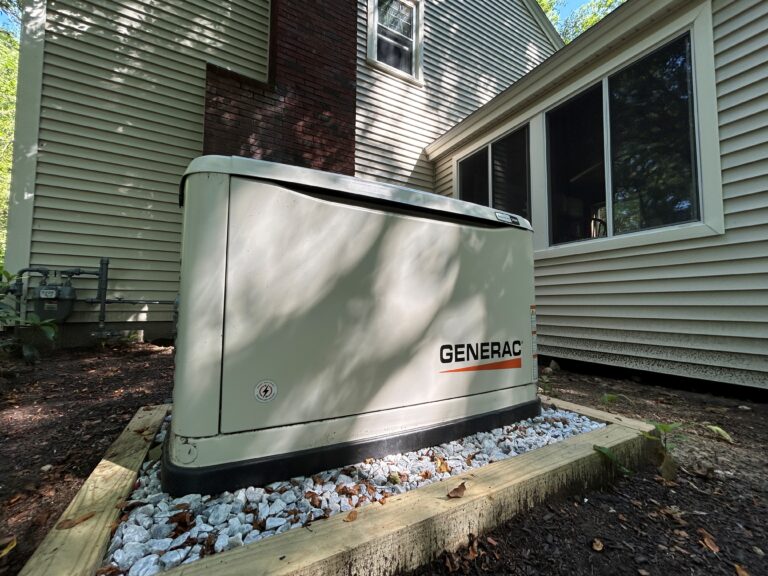
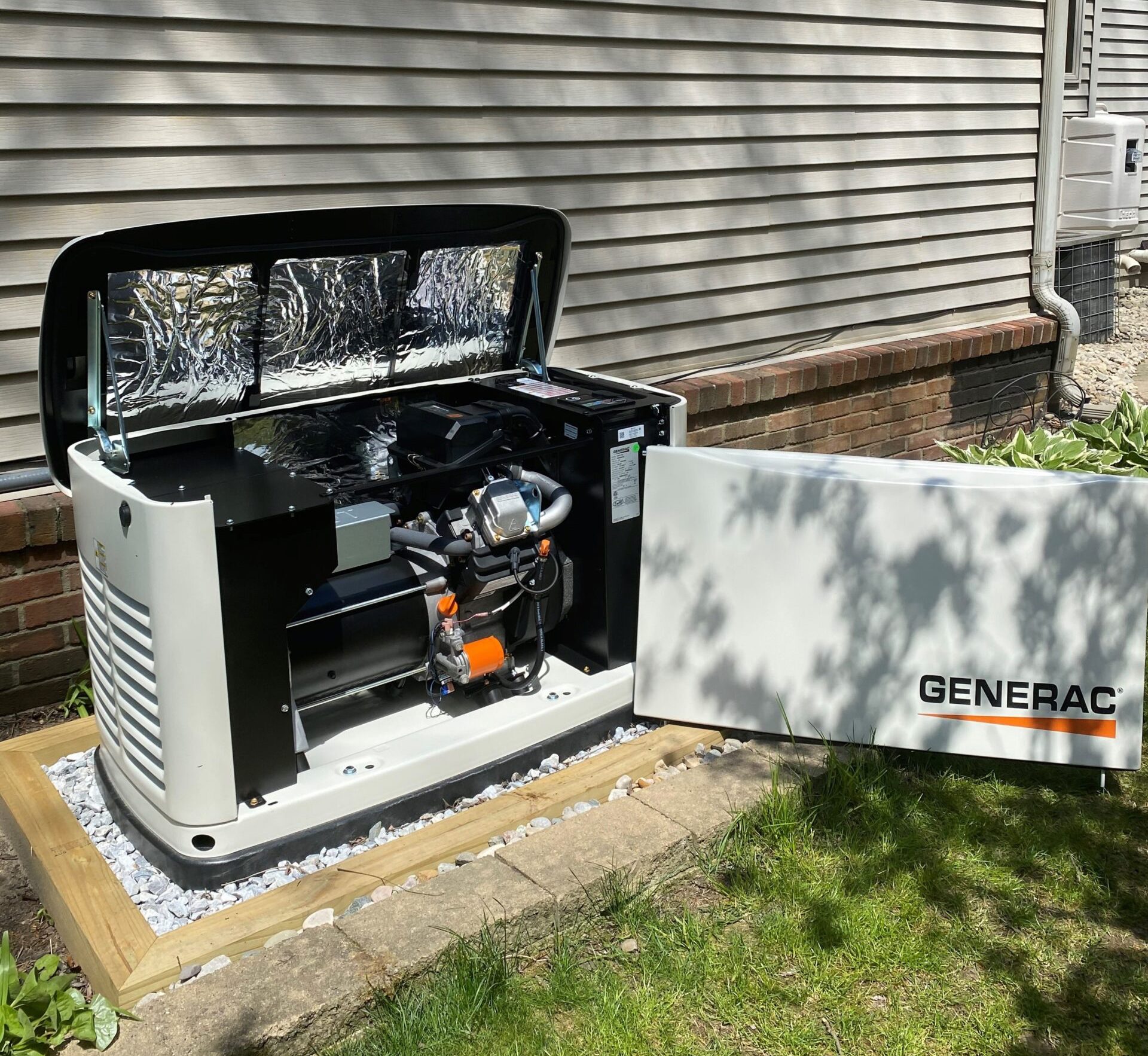
With a whole-house generator, your home automatically stays powered when storms take out the grid. A whole-house generator is a permanently installed backup generator that sits outside your home and runs on natural gas or propane. When utility power fails, it switches on within seconds and powers your home until the grid comes back.
Below, we explain how a standby generator works, what unit size makes sense for your home, and why backup power matters so much in a Vermont or New Hampshire winter.
How a Home Standby Generator Works
A home standby generator has 3 main parts: the generator, a fuel connection, and an automatic transfer switch. We install all 3 together.
The Generator
The generator sits on a pad outside your home, typically close to your propane tank or natural gas meter. Generac’s home standby generators average 65 to 67 decibels (dB), a volume similar to a central air conditioner. Generator output is measured in kilowatts (kW). A kilowatt is 1,000 watts, and a higher kW rating means the generator can run more appliances at once.
The Fuel Connection
A standby generator connects directly to your home’s natural gas line or propane tank, so you never refuel it by hand. We compare the 2 fuels later in the post.
The Automatic Transfer Switch
An automatic transfer switch (ATS) is an electrical device installed between your utility service and your home’s wiring. It monitors utility power at all times. When it senses an outage, it disconnects your house from the utility line, signals the generator to start, and connects your circuits to generator power.
What Happens During an Outage
- Utility power stops coming to your home.
- The ATS senses the outage and signals the generator to start.
- The generator starts and restores power to your home within seconds, even when no one is home.
- When utility power returns, the ATS switches your home back to the grid, and the generator shuts itself off until the next outage.
Between outages, the generator runs a short self-test on a set schedule. Our generator maintenance plans cover the oil changes, filters, and inspections that keep it ready.
Whole-Home Coverage vs. Essential Circuits
A standby generator can power your entire house or a selected group of circuits. We work through the right choice with you during the site visit.
Whole-Home Coverage
Whole-home coverage is what most people picture when they think of a whole-house generator. It keeps heating and cooling, kitchen appliances, and other high-draw systems running. The transfer switch connects to your main electrical panel, so every circuit stays powered during an outage.
Essential-Circuit Coverage
Essential-circuit coverage powers less, typically the refrigerator, lighting, well pump, furnace, and a few outlets. This approach uses a smaller generator, which can lower the installed price.
How Load Management Lets a Smaller Generator Cover More
Load management means briefly turning off lower-priority circuits so the generator can power the important ones. Generac’s Load Manager connects to high-draw appliances, such as central air conditioning. When the generator nears its limit, it pauses the lower-priority appliance until capacity is available.
With load management, a mid-size generator can often cover a whole house that would otherwise need a larger model. On a Generac 22kW, adding load managers can extend whole-home coverage from homes of about 2,000 square feet to about 3,000 square feet.
Motors in well pumps and air conditioners often need 2 to 3 times their running power to start. That’s why we start every standby generator installation with a review of your electrical panel and the appliances you want to keep running.
Why Standby Generators Fit Vermont and New Hampshire Homes
Think about how many outages you had last winter and how long each lasted. In Vermont and across New Hampshire’s Upper Valley and Sunapee Region, a long January outage affects much more than the lights.
Heating Systems
Most furnaces and boilers need electricity even when they burn oil, propane, or natural gas, because electricity runs their igniters, controls, blowers, and circulator pumps. Heat pumps run entirely on electricity.
Well Pumps and Sump Pumps
Many rural homes rely on a private well, and the well pump stops when the power does. Sump pumps matter most during spring thaw and heavy rain, when a basement can fill with water without power.
Frozen Pipes and Food Loss
In a cold house, water lines can freeze and burst, and food in the refrigerator and freezer can spoil over a multi-day outage. A whole-house generator keeps heat, water, and refrigeration running, so a winter storm is far less likely to leave you with burst pipes or spoiled food.
What Fuels a Standby Generator
Generac home standby generators run on natural gas or liquid propane (LP), and each generator is set up to use one fuel. The fuel already available at your home usually decides which one your generator will use. Output can differ slightly by fuel. Generac rates its current 22kW model at 22 kW on propane and 21 kW on natural gas, so we size your generator with your fuel in mind.
Natural Gas
Natural gas comes from your utility’s gas line, so the generator doesn’t draw down a stored supply as long as gas service continues. Natural gas lines don’t reach many rural roads in Vermont and New Hampshire, so this option is more common in and near larger towns. We can confirm if your gas meter and piping can supply the generator.
Propane
Propane is stored in a tank on your property, and many homes here already have one for heat, hot water, or cooking. Run time depends on your tank size and how much power your house draws. Generac rates its current 22kW model at about 2.5 gallons of propane per hour at half load. At the site visit, we review your tank and how long your fuel would last in an extended outage.
Generac Standby Models Available Through VGS
Vermont Generator Systems is an authorized Generac dealer, and we install Generac whole-home generators from 10kW to 28kW. Every standby electric generator in this range is air-cooled, which means the engine uses airflow through its enclosure to stay cool.
10kW and 14kW Generac Generators
The 10kW Generac generator can power a small home when paired with load management. The 14kW Generac generator powers essentials such as the refrigerator, furnace, and lights, and with load management on a small home, it can also run a well pump or central air conditioning.
18kW and 22kW Generac Generators
The 18kW Generac generator is a whole-home generator for homes up to about 2,000 square feet. The 22kW Generac generator is one of the most popular choices for Vermont and New Hampshire homes.
24kW, 26kW, and 28kW Generac Generators
The 24kW Generac generator covers larger homes of about 3,000 to 3,500 square feet. The 26kW Generac generator covers homes of about 2,500 to 4,500 square feet. The 28kW Generac generator covers homes of about 3,500 to 5,000 square feet, and with load management, homes up to 7,000 square feet.
Square footage is a starting point, but your final generator size depends on your home’s loads. Your heat source, well pump, and electric appliances can all change the answer.
Get a Whole-House Generator Quote From Vermont Generator Systems
Vermont Generator Systems has served homeowners across Vermont and New Hampshire since 2004, based in Hartford, Vermont. As an authorized Generac dealer, our in-house, certified technicians handle every step of your project: site visit, sizing, permitting, installation, and testing. After installation, we provide annual service and generator repairs.
We take a zero-pressure, educational approach. You’ll come away from your first conversation with a clear recommendation for your home. If you’d like to spread out the cost, ask about our generator financing options. You can read more about whole-home backup generators in Vermont and New Hampshire on our site or call us at (802) 698-8125.
Sources
Generac Power Systems. “Home Standby Generator FAQ.” https://www.generac.com/home-standby-generators/faq/
Generac Power Systems. “What Size Generator Do I Need?” Updated August 9, 2026. https://www.generac.com/resources/home-management/what-size-generator-do-i-need/
Generac Power Systems. “Standby Generator, 22kW | WiFi Enabled (G0070420),” product page and specifications. https://www.generac.com/residential-products/standby-generators/gaseous/22kw-standby-generator-wifi-enabled-7042/